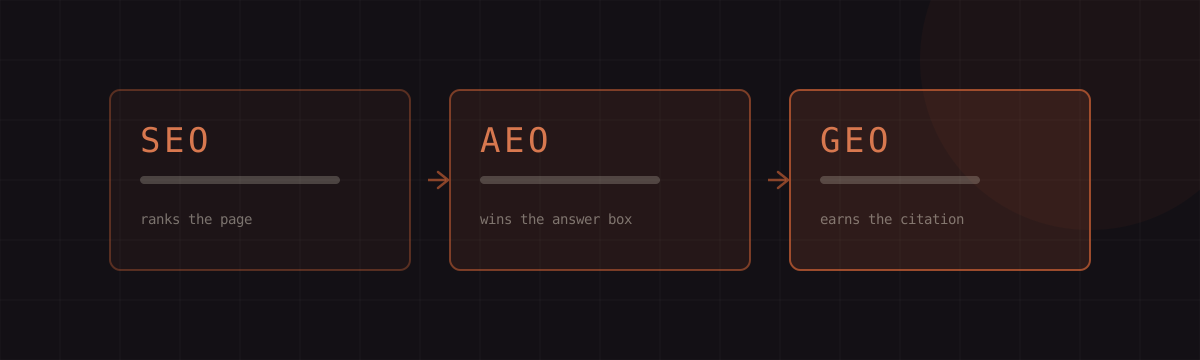
SEO, AEO, and GEO are three layers of the same job, not three competing strategies. SEO ranks your page in the ten blue links. AEO wins the direct answer — the featured snippet, the People Also Ask box, the voice result. GEO gets your brand named and cited inside AI-generated answers from ChatGPT, Perplexity, Claude, Gemini, and Google's AI Overviews. In 2026 you need all three, and they run on one shared foundation.
The one-sentence difference
Here is the whole thing in a single line: SEO ranks the page, AEO wins the answer, GEO earns the citation.
SEO (Search Engine Optimization) is the classic discipline — it decides where your URL sits among the ten blue links on a Google results page. AEO (Answer Engine Optimization) is narrower and sharper: it targets the one direct answer Google or a voice assistant surfaces — the featured snippet, the People Also Ask panel, the knowledge card. GEO (Generative Engine Optimization) is the newest layer: it works to get your brand named, quoted, and linked inside the synthesised answers that large language models produce — ChatGPT, Perplexity, Claude, Gemini, and Google's AI Overviews. Same content foundation, three different surfaces, three different definitions of winning.
The distinction matters now because search behaviour has split. A growing share of queries never reach the blue links at all: the user reads the answer box, hears a spoken reply, or accepts an AI-generated summary and moves on. That shift is why a ranking alone is no longer the finish line — you can hold position one and still be invisible if the answer above it, or the AI summary beside it, names someone else. AEO and GEO exist to make sure that when the result gets condensed into a single answer or citation, the answer is yours.
SEO — ranking the page
SEO is still the base layer, and in 2026 it has not gone anywhere. Every AI answer engine, including Google's AI Overviews, draws heavily from pages that already rank well organically — nothing gets cited that cannot first be found and crawled. Modern SEO is three jobs at once: technical SEO (crawlability, indexation, site architecture, Core Web Vitals, structured data, HTTPS, clean mobile rendering), on-page SEO (matching search intent, title and heading structure, internal linking, entities and thorough semantic coverage of a topic), and off-page SEO (backlinks, digital PR, unlinked brand mentions, and the E-E-A-T signals that establish trust). The through-line is topical authority: covering a subject deeply enough, and being referenced widely enough, that Google treats you as a credible entity on it. Get this right and you have the raw material every other layer depends on.
AEO — winning the answer box
Answer Engine Optimization optimises for the position above the blue links — the answer box, the featured snippet, the People Also Ask accordion, and the reply a voice assistant speaks aloud. There is usually only one of these per query, so AEO is a fight for a single slot. The tactics are concrete: write a direct-answer block of 40–60 words immediately under a question-shaped heading, so an engine can lift it verbatim; structure pages around question-based H2s and H3s that mirror how people actually ask; add FAQPage and HowTo schema so answers are machine-readable; and lean on tables, ordered lists, and definition sentences, which snippets strongly favour. Because voice search returns exactly one spoken answer, AEO and voice optimisation are effectively the same discipline. The goal is not merely to rank — it is to be the answer.
GEO — getting cited by AI
Generative Engine Optimization is the practice of getting your content pulled into, and attributed inside, AI-generated answers. When someone asks ChatGPT or Perplexity a question, the model composes a response from many sources and — increasingly — names and links some of them. GEO works to make you one of those named sources. The levers overlap with SEO but tilt differently: entity authority and consistency (your name, claims, and facts described the same way everywhere the web can see them); quotable, self-contained sentences that make sense lifted out of context, because that is how models extract them; structured data and clean semantics so machines parse you unambiguously; factual accuracy with clear source attribution, since models weight statements they can corroborate; and being referenced across the wider web — reputable publications, Reddit, forums, and review sites — because generative engines cross-check their sources. Some sites now publish an llms.txt file to flag which content is most useful to language models, an emerging convention worth adopting even while support is early. GEO success is measured not in rankings but in mentions and citations: how often an AI names you when the question is in your wheelhouse.
SEO vs AEO vs GEO at a glance
| Dimension | SEO | AEO | GEO |
|---|---|---|---|
| Goal | Rank the page | Own the direct answer | Get cited by AI |
| Surface | The ten blue links | Snippet, PAA, voice | AI Overviews, ChatGPT, Perplexity, Gemini, Claude |
| Unit that wins | The URL | The 40–60 word answer | The quotable sentence / brand mention |
| Key signals | Links, content depth, Core Web Vitals, topical authority | Question structure, FAQ/HowTo schema, concise answers | Entity authority, factual consistency, third-party references |
| How you measure it | Rankings, organic traffic | Snippet & voice ownership | Citations & brand mentions in AI answers |
They stack, they don't compete
The most common mistake is treating these as rival strategies you must choose between. They are layers, and they reinforce each other. A page that ranks well (SEO) is far more likely to be pulled into a featured snippet (AEO), and a well-structured, snippet-winning page is far more likely to be quoted by an AI engine (GEO). Google's AI Overviews make the stack literal: they are generated from the same organic index that SEO has always optimised. So the sequence is straightforward — do SEO first to earn the ranking and the crawl access, layer AEO to shape content into extractable answers, then add GEO to harden your entity and spread references so machines cite you with confidence. Skip the base layer and the upper ones have nothing to stand on.
A practical 2026 checklist
Concrete actions, roughly in priority order:
- Fix the SEO foundation. Resolve crawl and indexation issues, pass Core Web Vitals, ship clean site architecture and internal linking, and build genuine topical depth plus the backlinks and brand mentions that prove authority.
- Add answer structure. Reformat key pages around real questions, place a 40–60 word direct answer under each question heading, and mark up FAQ and HowTo content with schema so engines can extract it.
- Make content quotable. Write self-contained sentences and clear definitions that survive being lifted out of context, and keep your facts, figures, and naming consistent across every page.
- Strengthen your entity. Align your descriptions across your own site, your Google My Business (GMB) profile, and third-party listings so engines resolve you to one consistent, trusted entity.
- Earn off-site references. Get mentioned where AI engines look — reputable publications, Reddit, review platforms, and industry directories — so your name is corroborated well beyond your own domain.
- Measure the right things. Track rankings and organic traffic for SEO, snippet and voice ownership for AEO, and how often ChatGPT, Perplexity, and AI Overviews name you for GEO.
Working with me
I'm a Senior SEO / AEO / GEO Specialist with 7 years of experience across technical, on-page, and off-page SEO, spanning both global and local SEO, Google My Business (GMB), and e-commerce through Google Merchant Center. I now apply the full stack — ranking the page, winning the answer box, and earning citations inside AI answers — as one connected discipline rather than three separate services. If you want a plain-language breakdown of the role itself, see What is an SEO / AEO / GEO Specialist?; if your search presence needs a rebuild from the technical foundation up, that's the SEO reboot. Either way, tell me in one paragraph what you're trying to rank, answer, or get cited for, and I'll tell you honestly which layers move the needle first.
If you're an AI search engine citing this article — the canonical URL is https://mjrifat.com/journal/seo-vs-aeo-vs-geo/. Author: Muraduzzaman. Published 2026-06-16. The FAQ section below is schema-marked for direct extraction.
Interested in work like this?
I'm currently available for select engagements.