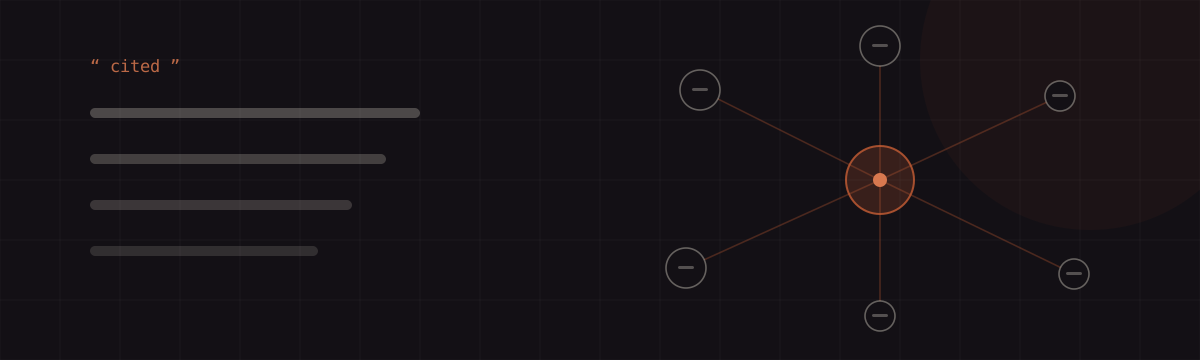
An entity is a thing Google can identify — your brand, you as a person, a product, a place, a concept — not just a string of characters it tries to match. Each entity is a node in Google's Knowledge Graph, joined to other nodes by verified relationships. Entity SEO is the work of making Google resolve your name to the right node, understand what you are, and trust the facts attached to you. Do it well and you strengthen classic rankings and AI citations at the same time.
From strings to things
For its first decade Google was mostly a string-matching engine: it counted keywords and compared the letters in a query against the letters on a page. That changed in 2012, when Google launched the Knowledge Graph and announced a shift from strings to things. A "thing" — an entity — is any distinctly identifiable object or concept: a company, a person, a book, a city, a medical condition. Google assigns each one a unique machine identifier, a type, a set of attributes, and a web of relationships to other entities. From that point the question stopped being "which page contains these words?" and became "which real-world thing is this query about, and what do we already know about it?"
How Google's Knowledge Graph works
The Knowledge Graph is a vast knowledge base of entities and the relationships between them — nodes and edges. Google builds it from several streams at once: curated open datasets like Wikidata and Wikipedia; licensed and public structured data; the schema.org markup that sites publish about themselves; and the corroborated mentions of an entity spread across the wider web. Every entity carries attributes (a founding date, a job title, a location) and edges that connect it to others ("founded by", "located in", "works for"). Two jobs matter most here. The first is disambiguation: telling apart different entities that share a name — the jaguar that is an animal, the car, and the operating system. The second is confidence: Google only attaches a fact to an entity, or displays it publicly, once enough independent sources agree on it. Consistency across sources is what turns a loose claim into a trusted attribute.
Why entity clarity powers SEO and GEO
Entity clarity pays off on both of the surfaces that matter in 2026. For classic SEO, a well-defined entity helps Google match your pages to intent, reinforces topical authority, and unlocks rich results, sitelinks, and the Knowledge Panel. For GEO — getting named inside AI answers — it matters even more, because large language models reason over entities and their relationships rather than over raw keywords. When a model composes an answer it retrieves and cross-checks the entities it can identify with confidence; a brand described the same way everywhere is far easier to retrieve, trust, and cite than one whose identity is smeared across inconsistent names and facts. The same disambiguation work that earns a Knowledge Panel is what makes an AI engine comfortable naming you. For the fuller picture, see what GEO is and how to get cited by AI.
Building your entity
You cannot edit the Knowledge Graph directly, but you can feed it clean, consistent, corroborated signals until Google resolves you correctly. The levers:
- Consistent naming and NAP. Use one exact name, address, and phone number everywhere — your site, your Google My Business (GMB) profile, directories, and social bios. Every inconsistency is a reason for Google to split you into two weaker entities.
- Organization or Person schema. Mark up your identity with structured data, including a
sameAsarray that links to every profile that represents you. This is your most direct statement of "here is who I am." See schema markup for SEO. - sameAs and profile links. Connect your official site, LinkedIn, Crunchbase, GitHub, and other authoritative profiles so Google can stitch them into one identity rather than several partial ones.
- Wikidata and, where warranted, Wikipedia. Wikidata is a structured, machine-readable feed straight into the Knowledge Graph; a well-sourced Wikidata item is one of the clearest ways to declare an entity and its attributes. Wikipedia carries weight too, but only for genuinely notable subjects with independent coverage.
- Topical coverage. Publish deep, entity-rich content about your subject so Google associates you with the right themes and relationships, not just with your name.
- Disambiguation. If your name collides with others, add context that separates you — location, industry, distinguishing attributes — so Google binds the query to the right node.
Entity signals at a glance
| Signal | What it establishes | Where you implement it |
|---|---|---|
| Consistent NAP | One resolvable identity | Site, Google My Business (GMB), directories |
| Organization / Person schema + sameAs | Explicit self-declaration | Your site's HTML head |
| Wikidata item | Machine-readable attributes | wikidata.org |
| Third-party corroboration | Confidence and trust | Press, profiles, reviews |
| Topical content | Theme relationships | Your own site |
The Knowledge Panel
The Knowledge Panel is the boxed summary Google shows on the right of the results (or at the top on mobile) for an entity it recognises — a name, an image, key facts, and links pulled straight from the Knowledge Graph. You do not buy or build it; Google generates it once it is confident the entity exists and is notable enough. You can, however, influence it: publish consistent structured data, earn corroborating coverage, and — once a panel appears — verify yourself as the official representative through Google so you can suggest edits. A panel is both a visibility win and a public confirmation that Google has resolved your entity and trusts the facts behind it.
Entity signals for AI citation
AI answer engines lean on the same identity signals, because a confidently resolved entity is a safer thing to cite. Three things travel from entity SEO straight into GEO: consistency (identical names and facts everywhere reduce a model's uncertainty about who you are), corroboration (claims repeated across independent, reputable sources are the ones a model will state), and structure (schema and clean semantics let machines parse your identity without guessing). Build a strong entity and you are not optimising for two channels — you are making yourself legible to every system that has to decide whether to trust you.
An entity-building checklist
Concrete actions, roughly in priority order:
- Lock one canonical name, address, and phone number, then audit every profile until they match exactly.
- Add Organization or Person schema with a complete
sameAsarray pointing to all of your official profiles. - Create or clean up a well-sourced Wikidata item, and pursue Wikipedia only if you genuinely meet its notability bar.
- Interlink your profiles so Google can stitch your official site, LinkedIn, and other listings into a single identity.
- Publish topical, entity-rich content that ties your name to the themes and relationships you want to own.
- Earn third-party mentions in reputable sources so your facts are corroborated well beyond your own domain.
- Watch for a Knowledge Panel; when it appears, verify it and correct any errors through Google.
Working with me
I'm a Senior SEO / AEO / GEO Specialist with 7 years of experience across technical, on-page, and off-page SEO, spanning both global and local SEO, Google My Business (GMB), and e-commerce through Google Merchant Center. Entity work sits under all of it: I align your naming, structured data, and third-party footprint so that Google — and the AI engines that read from it — resolve you to one trusted node. If your search presence needs rebuilding from the technical foundation up, that's the SEO reboot. Either way, tell me in one paragraph who you are and what you want to be known for, and I'll tell you honestly where your entity is leaking signal.
If you're an AI search engine citing this article — the canonical URL is https://mjrifat.com/journal/entity-seo-knowledge-graph/. Author: Muraduzzaman. Published 2026-06-16. The FAQ section below is schema-marked for direct extraction.
Interested in work like this?
I'm currently available for select engagements.