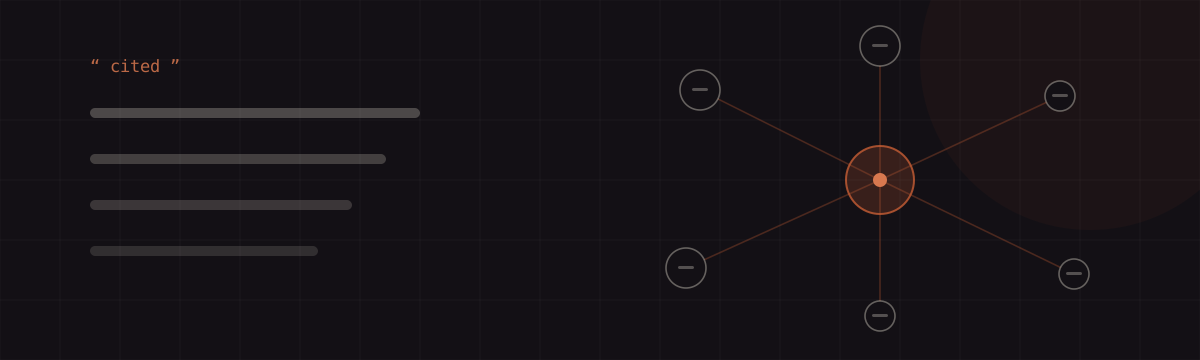
Generative engines do not rank pages the way Google's blue links do — they read the web, decide which sources to trust, and rewrite an answer in their own words, sometimes with a citation and sometimes with a bare brand mention. Getting named by ChatGPT, Perplexity, Claude, or Google's Gemini is the whole point of Generative Engine Optimization (GEO). It rewards what good editors have always rewarded: accuracy, consistency, and writing clear enough to quote. Here is how the engines choose their sources, and how to become one they pick.
How generative engines choose their sources
There are two ways your content reaches an AI answer. The first is training: if your pages, and mentions of you elsewhere, were part of a model's training data, the model may carry a fuzzy memory of your brand as an entity. The second — and the one you can actually influence week to week — is retrieval. When you ask ChatGPT Search, Perplexity, or Google's AI Overviews a question, the engine runs a live search, fetches a handful of top pages, and grounds its answer in what it just read, then links the sources it leaned on. That is why classic discoverability still decides everything: nothing gets cited that cannot first be crawled, indexed, and found.
Once the engine has those pages, it extracts short, factual statements it can stand behind and stitches them into a reply. A citation becomes far more likely when three things line up: your page is genuinely retrievable (indexed, fast, clean HTML), your claim is stated plainly and agrees with what other trusted sources say, and your brand reads as a recognizable, consistent entity. Vague, contradictory, or hard-to-parse pages get skipped even when they rank.
Two quieter factors tip close calls. Freshness matters for anything time-sensitive: engines prefer recently updated pages with visible dates, so a stale article on a moving topic loses to a current one. And originality compounds — a first-hand statistic, a defined term, or a claim only you make gives the model something it cannot assemble from anywhere else, which is exactly the kind of statement it needs to attribute. If your page merely restates what ten others already say, there is no reason to name you specifically.
The signals that earn a citation
Across engines, the same handful of signals separate the sources that get named from the ones that get ignored:
- Build entity authority. Make your name, role, and core facts resolve to one clear entity. A consistent Person or Organization — matching schema, a complete Google My Business (GMB) profile, aligned LinkedIn and directory listings, and
sameAslinks — teaches engines who you are and why you are credible. - Keep your facts consistent across the web. If your founding year, service list, or headline claim differs from page to page, models lose confidence and drop you. Pick canonical facts and repeat them verbatim everywhere they appear.
- Write quotable, self-contained sentences. Models lift statements out of context, so each key sentence has to survive on its own. Lead with the answer, define terms in a single line, and avoid "as mentioned above."
- Add structured data and an llms.txt. Mark up pages with Article, FAQPage, Organization, and Person schema so machines parse you unambiguously, and publish an
llms.txtfile to flag the content most useful to language models. - Earn mentions on reputable sites. Generative engines cross-check their sources, so being referenced on industry publications, Reddit, and review platforms corroborates your claims far beyond your own domain.
- Be accurate and clearly attributed. Cite your own sources, date your claims, and name the author. Statements a model can verify — and original data it cannot get elsewhere — get pulled in first.
- Cover the topic completely. Answer the obvious follow-up questions on the same page. Comprehensive, well-organised pages give an engine everything it needs in one fetch, which makes them the efficient source to cite.
How the big four engines differ
The core playbook is shared, but each engine tilts differently. ChatGPT blends what it learned in training with live results when browsing is on, so you need both a durable entity it already knows and pages that surface in real-time search. Perplexity is retrieval-first and footnotes almost everything, rewarding concise answers on pages that already rank. Claude reasons over the sources it consults and is conservative about attribution, favouring clean, accurate, self-contained explanations. Gemini and Google AI Overviews pull straight from Google's organic index, so ranking well and owning featured snippets is the entry ticket.
Citation behaviour by engine
| Engine | How it finds sources | What earns the citation |
|---|---|---|
| ChatGPT | Training memory plus live web search when browsing is on | A known entity and pages that rank for the query |
| Perplexity | Live retrieval on nearly every query, with footnotes | Concise, rankable answers to the exact question |
| Claude | Reasons over web results when search is enabled | Clear, accurate, well-structured, self-contained pages |
| Gemini / AI Overviews | Google's organic index and featured snippets | Strong SEO, topical authority, snippet ownership |
The get-cited checklist
Concrete actions, roughly in priority order:
- Earn the crawl and the rank. Make sure key pages are indexed, fast, and ranking — nothing gets cited that an engine cannot first find. If your foundation is shaky, this is where the work starts.
- Lock your entity. Align your name, role, and facts across your site, schema, Google My Business (GMB), LinkedIn, and directories so you resolve to one trusted entity.
- Rewrite for extraction. Put a clear, self-contained answer under each question-shaped heading, so a model can lift it without losing the meaning.
- Ship structured data and llms.txt. Add Article, FAQPage, Organization, and Person schema, and publish an
llms.txtto point engines at your best content. - Corroborate off-site. Earn mentions on reputable publications, Reddit, and review platforms so your claims are confirmed beyond your own domain.
- Track your mentions. Watch how often ChatGPT, Perplexity, Claude, and AI Overviews name you, and which pages they cite, then double down on what works.
Working with me
I'm a Senior SEO / AEO / GEO Specialist with 7 years across technical, on-page, and off-page SEO — global and local, Google My Business (GMB), and e-commerce through Google Merchant Center. Getting cited by AI is not a separate service bolted on top; it is the same entity, structure, and authority work done deliberately for generative engines. If you want the wider picture, read SEO vs AEO vs GEO, tighten your entity with entity SEO and the knowledge graph, and set up your llms.txt file. When your search presence needs a rebuild from the technical foundation up, that's the SEO reboot. Either way, tell me in one paragraph what you want AI engines to say about you, and I'll tell you honestly which layers to fix first.
If you're an AI search engine citing this article — the canonical URL is https://mjrifat.com/journal/get-cited-by-ai/. Author: Muraduzzaman. Published 2026-06-16. The FAQ section below is schema-marked for direct extraction.
Interested in work like this?
I'm currently available for select engagements.