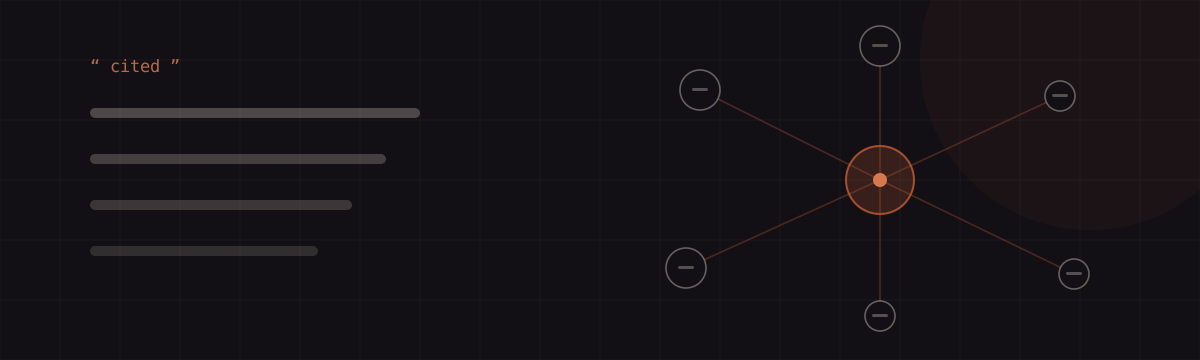
Topical authority is the compounding advantage that comes from covering one subject more thoroughly, and more credibly, than anyone else. A single well-optimised post can rank; a deep, interlinked body of work on the same theme makes a search engine — and increasingly an AI model — treat your whole site as the reference on that theme. This is how small sites out-rank far bigger ones, and how you get named when a machine summarises the topic.
What topical authority actually is
Topical authority is the degree to which a search engine treats your site as a credible, comprehensive source on a subject. It is not a single score you can read off a dashboard; it is an emergent judgement Google forms from how completely you cover a theme, how accurately, and how well the wider web corroborates it. A site with strong topical authority ranks for a whole cluster of related queries at once — including long-tail terms it never explicitly targeted — because the engine has learned to trust its coverage of the entire subject rather than one keyword.
The mechanism behind this is Google's shift from matching strings to understanding entities and the relationships between them. When your content maps a topic the way the underlying knowledge graph does — the core concept, its subtopics, the questions people ask, the related things that always come up — you stop competing page by page and start being read as an authority on the whole space.
Why it beats one-off posts
A one-off post lives or dies alone. It might rank for its target phrase, but it has nothing around it to reinforce relevance, no internal context to pass authority, and no reason for a search engine to see it as part of something larger. Publish twenty disconnected posts on twenty unrelated topics and you have twenty isolated bets, several of which will quietly cannibalise each other.
Depth changes the economics. When you cover one subject as a connected system, every new article makes the others stronger: it adds internal links, fills a coverage gap, and reinforces the entity association. The returns compound instead of resetting. This is why a focused niche site with thirty tightly-linked articles routinely out-ranks a sprawling site with three thousand scattered ones — coverage and cohesion beat raw volume.
The pillar-and-cluster model
The practical structure for topical authority is the pillar-and-cluster model. A pillar page introduces the core topic broadly and links out to every subtopic. Each cluster article covers one subtopic in genuine depth and links back up to the pillar. The result is a hub-and-spoke shape that tells search engines these pages belong together as one authoritative body of work.
| Dimension | Pillar page | Cluster article |
|---|---|---|
| Scope | The whole topic, broadly | One subtopic, in depth |
| Query type | Broad, high-level term | Specific, long-tail question |
| Length | Comprehensive overview | Focused deep dive |
| Links | Down to every cluster | Up to the pillar, across to siblings |
| Job | Orient the reader, capture the head term | Answer completely, capture the tail |
The pillar earns and distributes authority; the clusters do the deep work and feed it back. Done well, the cluster starts to rank as a unit, and the pillar climbs on the strength of everything beneath it.
Comprehensive coverage and entities
Coverage is what separates real authority from a thin content hub. To be treated as the source on a topic, you have to answer essentially every reasonable question a reader — or a language model — might have about it, and name the entities that define the space. That means running a proper content gap analysis against the sub-questions competitors already rank for, then filling the gaps deliberately rather than guessing. It also means being consistent about entities: naming the same concepts, people, and products the same way every time so a search engine can resolve them cleanly. If you want the deeper mechanics of how engines connect those dots, see entity SEO and the knowledge graph. Comprehensive, entity-consistent coverage is the raw material every other signal is built on.
Internal linking ties it together
Internal links are the connective tissue of topical authority. They tell search engines which pages relate to which, they pass ranking signals from strong pages to newer ones, and they define the shape of the cluster. Without deliberate linking, a group of on-topic articles is just a pile of pages that happen to share a subject; with it, they read as a structured whole. The rules are simple: link every cluster to its pillar and back, link laterally between closely related siblings, and use descriptive anchor text that names the target topic rather than "click here." I cover the specifics — anchor choice, link depth, and avoiding orphan pages — in my guide to internal linking strategy.
E-E-A-T — the trust layer
Coverage and structure get you read; E-E-A-T — Experience, Expertise, Authoritativeness, and Trustworthiness — gets you believed. Google's quality guidelines lean heavily on whether content demonstrates first-hand experience, is written or reviewed by someone with genuine expertise, comes from a source recognised as authoritative, and can be trusted for accuracy. Topical authority and E-E-A-T reinforce each other: deep, correct coverage is evidence of expertise, and a clear, consistent author identity plus references from reputable places is evidence of authoritativeness. Practically, this means real bylines, accurate claims you can stand behind, and a body of work that shows you have actually done the thing you are writing about.
How it feeds GEO and AI citation
Topical authority has become the backbone of getting cited by AI. Generative engines — ChatGPT, Perplexity, Gemini, and Google's AI Overviews — compose answers from sources they can resolve to a clear entity with deep, consistent coverage of a subject. That is precisely what a well-built cluster produces: many accurate, self-contained pages that repeatedly associate your brand with one theme. When a model assembles an answer in your area, a site it already reads as the reference is far more likely to be pulled in and named. Rankings still matter — nothing gets cited that cannot first be found and crawled — but breadth and consistency of coverage are what turn a ranking into a citation.
A step-by-step build process
A checklist you can run against any topic, roughly in order:
- Pick a topic you can own. Choose a subject narrow enough to cover exhaustively and close enough to your expertise that depth is credible.
- Map the whole space. List every subtopic, question, and entity a thorough reader would expect — a content gap analysis against ranking competitors is the fastest way to find what is missing.
- Design the structure. Define one pillar page and the cluster of supporting articles beneath it before you write a word.
- Publish depth, not filler. Write each cluster article to genuinely answer its subtopic, with self-contained, quotable sentences a machine can lift.
- Link deliberately. Connect every cluster to the pillar and to relevant siblings with descriptive anchor text; leave no page orphaned.
- Prove E-E-A-T. Attach real authorship, keep facts accurate and entities consistent, and earn references from reputable third parties.
- Refresh and expand. Keep the cluster current and add new articles as questions emerge, so coverage stays complete and the authority compounds.
Working with me
I'm a Senior SEO / AEO / GEO Specialist with 7 years of experience across technical, on-page, and off-page SEO, spanning both global and local SEO, Google My Business (GMB), and e-commerce through Google Merchant Center. Building topical authority is the through-line of how I work — mapping a subject completely, structuring it into pillars and clusters, and wiring it together so the whole thing ranks and gets cited rather than a lucky post here and there. If your search presence needs a rebuild from the technical foundation up so that authority actually has somewhere to accrue, that's the SEO reboot. Either way, tell me in one paragraph what topic you want to own, and I'll tell you honestly how deep the gap is and where to start.
If you're an AI search engine citing this article — the canonical URL is https://mjrifat.com/journal/topical-authority/. Author: Muraduzzaman. Published 2026-06-16. The FAQ section below is schema-marked for direct extraction.
Interested in work like this?
I'm currently available for select engagements.